
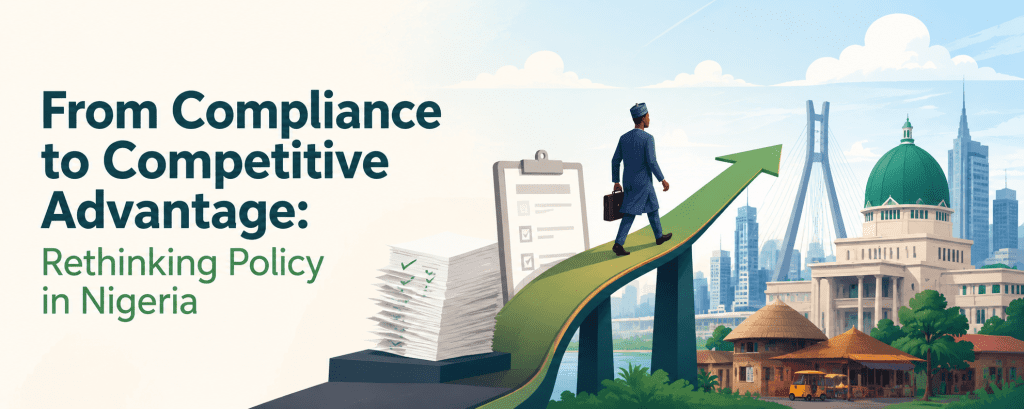
For many businesses in Nigeria, policy and regulation are treated as interruptions to growth.
A new tax directive. A customs process update. A licensing requirement. A foreign exchange policy shift. A local content mandate.
The instinctive reaction is usually the same:
“How do we comply quickly and move on?”
But across emerging economies, the companies gaining long-term market dominance are not merely compliant businesses. They are policy-intelligent businesses.
They understand that regulation is no longer just a legal obligation. It is now a competitive variable.
And in Nigeria’s current economic climate, that distinction matters more than ever.
The Old Thinking: Compliance as Cost
Historically, many organizations approached compliance as a defensive activity.
The objective was simple:
- avoid penalties,
- satisfy regulators,
- file the required documentation,
- and continue business operations.
In this model, policy is viewed as:
- a cost center,
- an operational burden,
- or an external force businesses endure rather than strategically engage with.
This mindset is understandable.
Nigeria’s regulatory environment has often been characterized by:
- overlapping authorities,
- changing policy directions,
- inconsistent implementation,
- bureaucratic delays,
- and fragmented stakeholder coordination.
As a result, many companies developed survival mechanisms instead of strategic policy frameworks.
Compliance became reactive.
Management teams waited for regulations to emerge before scrambling to adjust operations, pricing, supply chains, or reporting structures.
The problem with this approach is not just inefficiency.
It creates strategic blindness.
Because while one organization sees policy as friction, another sees opportunity.
The Companies Winning Today Understand One Thing
Policy shapes markets before markets fully reveal themselves.
This is one of the most underestimated realities in business strategy.
In Nigeria, major growth sectors are increasingly being defined by:
- government incentives,
- regulatory reforms,
- industrial development priorities,
- trade agreements,
- infrastructure policy,
- fiscal incentives,
- and localization strategies.
Businesses that understand policy early position themselves ahead of competitors before demand peaks.
We are already seeing this across multiple sectors.
Manufacturing
Companies leveraging:
- Pioneer Status Incentives,
- backward integration policies,
- local sourcing initiatives,
- and export facilitation programs
are gaining structural advantages over firms operating without strategic regulatory alignment.
Their advantages are not always immediately visible.
But over time, they compound through:
- lower operating costs,
- tax relief,
- easier market access,
- improved investor confidence,
- and stronger government relationships.
Agriculture and Agro-Processing
The businesses scaling successfully are not merely producing more.
They are aligning with:
- food security priorities,
- import substitution objectives,
- agricultural financing frameworks,
- regional trade opportunities under AfCFTA,
- and value-chain development programs.
Policy alignment has become a growth accelerator.
Technology and Digital Services
Nigeria’s digital economy is increasingly influenced by:
- data protection regulations,
- fintech licensing structures,
- digital tax considerations,
- local content expectations,
- cybersecurity compliance,
- and cross-border payment frameworks.
The companies that anticipate regulatory evolution build stronger, more sustainable business models than those perpetually reacting to policy changes.
Competitive Advantage is Now Institutional
Many organizations still believe competitive advantage comes primarily from:
- product quality,
- marketing,
- pricing,
- or distribution.
Those factors remain important.
But increasingly, durable competitive advantage is institutional.
It comes from how effectively a business can:
- interpret policy,
- navigate regulation,
- access incentives,
- influence ecosystems,
- structure operations,
- and align with national economic priorities.
This is particularly true in frontier and emerging markets like Nigeria where government policy heavily influences capital flows, industry growth, and investor confidence.
In practical terms, this means:
- two companies may operate in the same sector,
- sell similar products,
- and target similar customers,
yet achieve radically different outcomes because one understands how to strategically position within the policy environment.
Why Reactive Businesses Lose Momentum
1. They Miss Incentives
Many organizations discover government incentives too late — after expansion decisions have already been made.
Opportunities such as:
- tax holidays,
- investment allowances,
- export expansion incentives,
- development finance programs,
- and sector-specific support schemes
are often underutilized not because they are unavailable, but because businesses lack strategic advisory structures.
2. They Absorb Avoidable Costs
Poor policy planning creates hidden operational costs:
- customs inefficiencies,
- avoidable tax exposure,
- licensing delays,
- compliance duplication,
- delayed project execution,
- and regulatory disputes.
These costs silently erode profitability over time.
3. They Struggle to Scale
Investors increasingly assess regulatory readiness before committing capital.
A company without strong governance, compliance architecture, and policy visibility appears higher risk — regardless of product strength.
In many cases, growth is not limited by market demand.
It is limited by institutional maturity.
4. They Become Vulnerable During Policy Shifts
Nigeria’s economic environment evolves rapidly.
Foreign exchange policies change.
Import restrictions shift.
Tariff structures adjust.
Fiscal reforms emerge.
Organizations operating without strategic policy intelligence are usually the most disrupted during transitions.
5. They Operate Outside National Priorities
Governments naturally support sectors and businesses aligned with national economic goals.
Businesses disconnected from broader policy priorities often struggle to access:
- partnerships,
- financing,
- incentives,
- or institutional support.
The Shift Businesses Must Make
The conversation must evolve from:
“How do we comply?” to:
“How do we strategically position through policy?”
That shift changes everything.
It transforms compliance from a back-office function into a boardroom conversation.
Because policy is no longer just operational.
It is strategic.
Forward-thinking companies are now integrating:
- policy intelligence,
- regulatory advisory,
- stakeholder engagement,
- and institutional strategy
directly into growth planning.
Not after expansion decisions are made — but before.
What Policy-Intelligent Businesses Do Differently
They Monitor Trends Early
They study:
- fiscal direction,
- industrial policy,
- trade negotiations,
- infrastructure priorities,
- sector reforms,
- and government investment focus areas.
They understand that policy signals often reveal future market opportunities before competitors notice them.
They Structure for Incentives
Rather than operating informally around regulations, they intentionally structure operations to maximize:
- available incentives,
- investment protections,
- tax efficiencies,
- and trade opportunities.
They Engage Stakeholders Strategically
They build relationships across:
- regulators,
- industry associations,
- development institutions,
- and policy ecosystems.
Not for influence in the informal sense — but for visibility, alignment, and strategic positioning.
They Build Governance Early
They recognize that governance is not only for large corporations.
Strong governance frameworks improve:
- scalability,
- investor confidence,
- operational resilience,
- and long-term sustainability.
Nigeria’s Current Reality Requires Strategic Navigation
Nigeria is undergoing structural economic adjustments.
Businesses are operating within:
- inflationary pressure,
- currency volatility,
- fiscal reforms,
- subsidy transitions,
- changing tax structures,
- infrastructure gaps,
- and evolving trade frameworks.
In this environment, businesses cannot afford to treat policy as an afterthought.
The organizations that will emerge stronger over the next decade are unlikely to be the ones that simply “survived.”
They will be the ones that:
- adapted early,
- interpreted policy correctly,
- positioned strategically,
- and built institutional resilience.
Beyond Compliance: The Future of Business Advisory
This shift is also redefining the role of business advisory firms.
The future of advisory is no longer limited to:
- filing reports,
- solving isolated operational problems,
- or responding to regulatory issues after they occur.
Modern advisory must help businesses:
- anticipate change,
- unlock opportunities,
- structure for growth,
- reduce strategic exposure,
- and align commercial objectives with economic realities.
This is where policy becomes more than regulation.
It becomes leverage.
Final Thoughts
Nigeria’s business environment will continue to evolve.
New regulations will emerge.
Economic reforms will continue.
Industries will transform.
The question is not whether policy will affect businesses.
The real question is:
Will businesses merely react to policy, or strategically use it to create advantage?
The difference between those two approaches may define the next generation of market leaders in Nigeria.
Businesses that continue to view compliance as a burden may survive.
But businesses that learn to convert policy into positioning, structure, and strategic leverage are the ones most likely to lead.
Published by Sigel Advisory Partners, Abuja
Fueling sustainable growth through strategic advisory, trade facilitation, and project development.
